

Oil-filled radiator or fan heater? Which heats a room better and what it costs
A fan heater warms instantly, an oil-filled radiator holds heat longer. We compare both, show how to calculate running costs and how to match the power to your room.
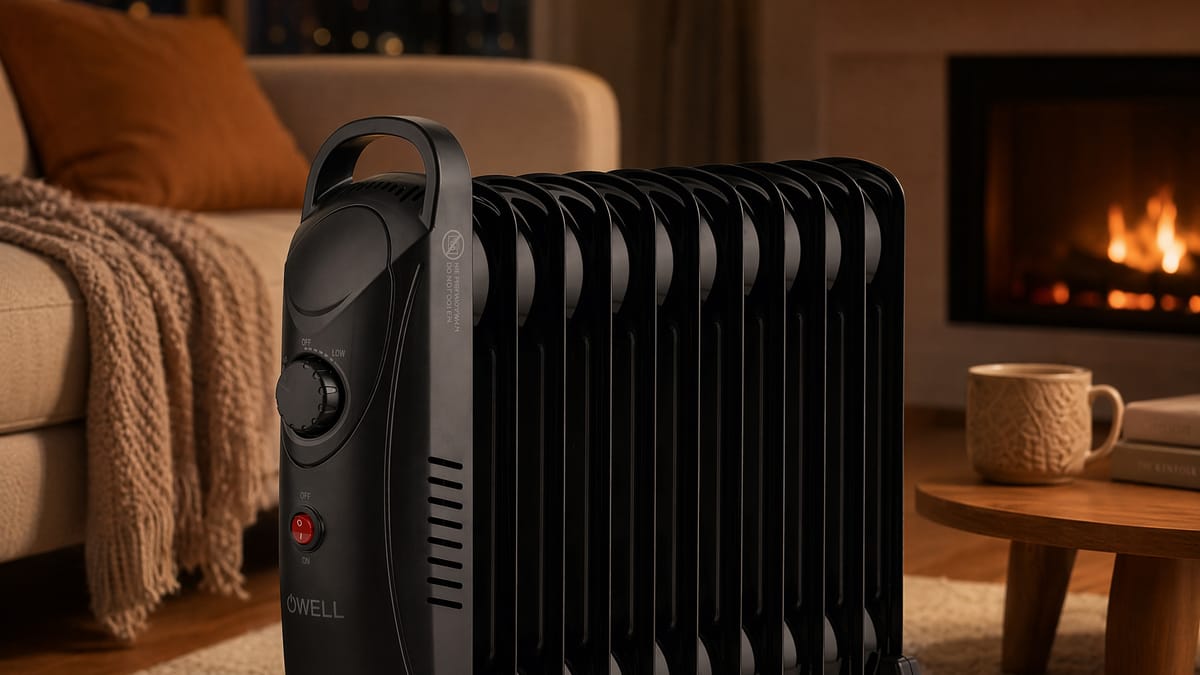
When the central heating isn’t enough or the heating season hasn’t started yet, the choice usually comes down to two types of electric heater: an oil-filled radiator and a fan heater. Both turn electricity into heat with practically the same efficiency — what differs is how they give it off. That decides which one suits you better.
How they work
A fan heater has a heating element and a fan that blows air through it. You feel the warmth within seconds, but once it is switched off the room cools down quickly. The fan is audible.
An oil-filled radiator has a heating element immersed in oil sealed inside the fins. The oil takes about a quarter of an hour to heat up and then gives off warmth across the whole surface of the fins — gently and evenly. After switching off it keeps radiating heat for a long time. With no fan, it is practically silent.
Which to choose
| Oil-filled radiator | Fan heater | |
|---|---|---|
| Heating up | slower, about a quarter of an hour | instant |
| Warmth after switching off | long | short |
| Noise | practically silent | fan audible |
| Best for | keeping a room warm for hours | quick, short bursts of heat |
Choose an oil-filled radiator if you want to top up the heat in a bedroom, office or child’s room for hours — at night too, because it won’t disturb you. Choose a fan heater if you want to quickly warm the bathroom before a shower or the garage for a quarter of an hour.
What it costs
A 1200 W appliance at full power uses 1.2 kWh per hour — whether it’s oil or a fan. You can calculate the cost yourself: power × running time × price per kWh from your electricity bill. At an example price of €0.35 per kWh, an hour at full power costs about €0.42.
In practice, an appliance with a thermostat runs at full power only until the room reaches the set temperature — after that the element switches on only occasionally, so the actual cost is lower. Closed doors help, as does a free-standing heater with no furniture or curtains in front of it.
The right power
For supplementary heating, a rough rule is about 100 W per m² at a typical ceiling height:
- OW 7832 — 800 W, 7 fins: small bedroom, bathroom, study up to about 8 m²,
- OW 7833 — 1000 W, 9 fins: rooms of about 10 m²,
- OW 7834 — 1200 W, 11 fins: rooms of about 12 m² or poorly insulated spaces.
In older buildings, under the roof or with large windows, go one size up. The thermostat will switch off anyway once the room is warm.
Safety
All three oil-filled radiators have a continuously adjustable thermostat, overheat protection, a power indicator light and a steel housing on stable feet. Place the radiator away from curtains, bedding and furniture, never dry clothes on it and don’t put it where it can easily be knocked over.
- guide
- home