

Hair clippers at home: how to pick the right guard and not ruin your haircut
The wrong guard, or cutting in the wrong direction, can ruin a haircut in seconds. We explain how the length-adjustment system actually works and what to watch for when cutting hair at home.
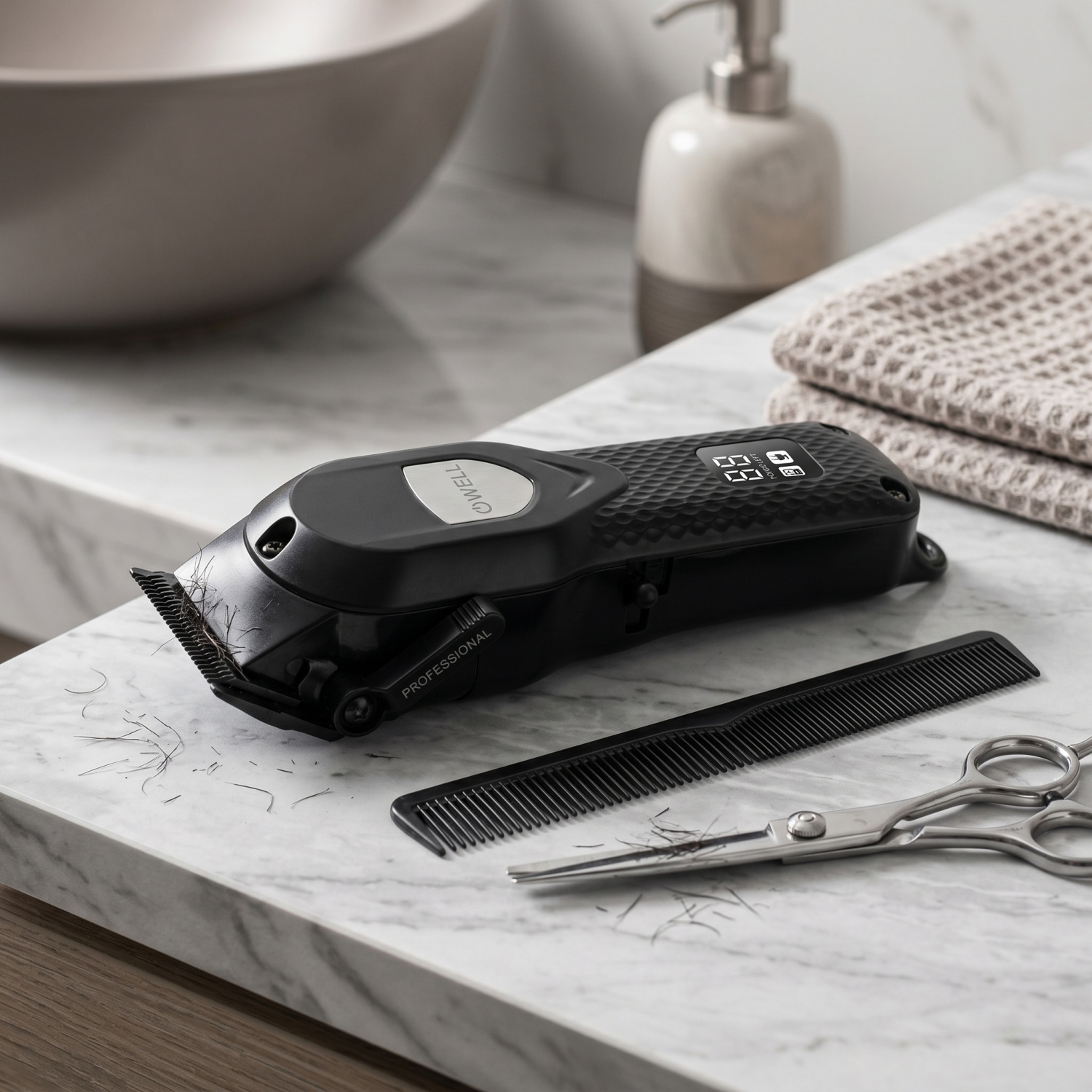
Cutting your hair at home saves time and money, but one wrong guard can undo an effect you’ve been working toward for months. Unlike at the barber, you don’t get a same-day do-over — so it’s worth understanding how the length-adjustment system actually works before you switch the clipper on.
The lever and the guards are not the same thing
Most clippers have two independent ways of adjusting length, which are easy to mix up:
- The lever changes the gap between the clipper’s own blades, with no guard attached — this gives the shortest, most precise cuts, usually in the 0.8–2 mm range. It’s used for contouring, lines and very short styles.
- Guide combs fit over the blade and extend the cut by a few millimetres to over a centimetre — these are the “numbers” you know from barbershops (e.g. a 6 mm guard is the popular “number 6”).
Combining both mechanisms gives you one continuous length range instead of a handful of fixed options — that combination is exactly what lets the same clipper shave stubble down to zero and leave 13 mm on top in the same session.
Which setting for which style
- 0.8–1.2 mm (lever only, no guard) — contours, side lines, very short stubble.
- 3–6 mm (shortest guards) — a classic “short” haircut, the sides of a fade.
- 10–13 mm (longest guards) — the top of the head on styles with a length contrast, longer but still tidy stubble.
If you’re not sure, always start with a longer guard. You can shorten hair at any point — you can’t lengthen it back.
Common mistakes when cutting hair at home
- Cutting against the grain on the first pass instead of with it — start by running the clipper in the direction hair grows; only later passes against the grain are for evening things out.
- Moving too fast — the clipper needs a moment of contact with the hair for the blade to cut it evenly, not just brush past it.
- A dirty or dull blade — hair starts catching and tugging instead of being cut cleanly, which you’ll feel and hear immediately.
- Pressing too hard — the clipper is meant to glide over the skin on its own; forcing it down increases the risk of uneven patches.
What to look for when choosing a clipper
Beyond the cutting-length range itself, three things really determine the result: blade quality (whether it’s designed not to pull hair), runtime per charge (so you’re not interrupted halfway through), and how convenient charging is day to day.
Our OW 2856 model has a Black Diamond Carbon DLC blade running at 6500 rpm, four guide combs (3 / 6 / 10 / 13 mm) and a lever with four additional settings (0.8–2.0 mm), together giving a continuous 0.8–13 mm range. A 2000 mAh battery lasts up to 210 minutes of use, and it charges over USB — no dedicated charger to lose.
- guide
- grooming